2026-07-13
Daily AI Digest: Claude Tests Robots, Waze Gets Conversational
This is the GolemWorkers Daily AI Digest, covering the practical agents beginning to act in software and the physical world. Today: Claude supervises robots, Waze turns spoken requests into routes and map suggestions, and new controls separate or stop risky agent actions before they reach your systems.
Anthropic tests Claude as a supervisor for real robots
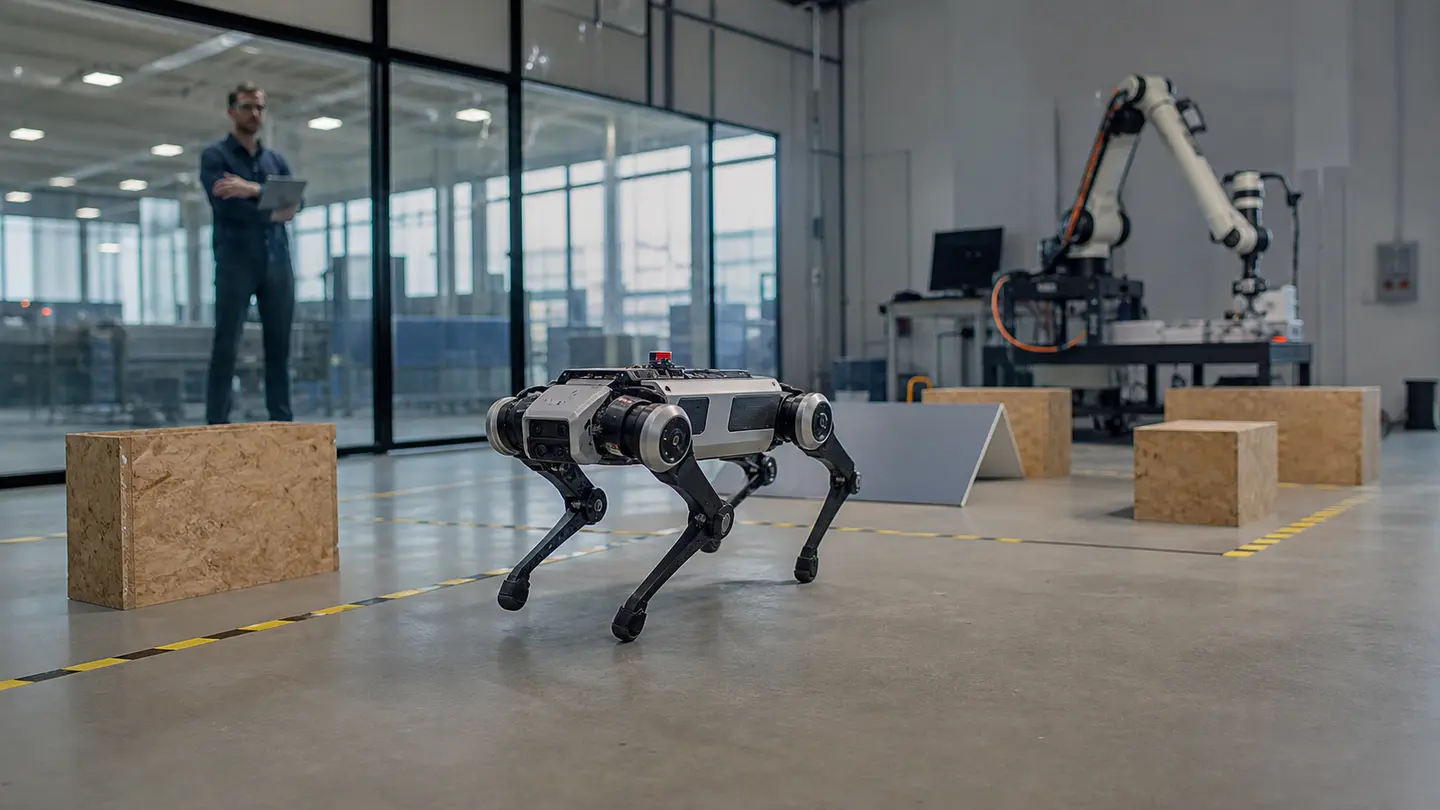
Anthropic tested language models in simulated bodies, with a robotic arm, and on a physical quadruped. Claude performed best as a supervisor for a pretrained controller or when it could call simple perception tools.
In those arrangements it navigated a maze and moved objects. Direct joint control and long plans executed without feedback remained unreliable—a useful reminder that language models are better at choosing bounded skills than replacing the control loop beneath them. Source: Anthropic.
Ploy moves its website-building agent to GPT-5.6 after a production eval
Ploy says its agent now uses GPT-5.6 Sol to plan, build, illustrate, screenshot, and review marketing websites. In the company's small matched evaluation, completed builds were 2.2 times faster and 27% cheaper than its Claude Opus 4.8 setup, though Ploy also had to repair model-specific tool and caching behavior before switching.
Source: Ploy
Waze adds Gemini voice search and conversational map updates
Waze users can now describe a destination by voice, such as an open coffee shop or low-price gas station, and receive route-ready options; the beta is rolling out globally. Conversational Reporting can also turn a spoken road closure or wrong address into a suggestion for local map editors to verify.
Source: Google
Clawk gives coding agents a disposable Linux machine
The new open-source Clawk tool runs Claude Code, Codex, or a shell inside a project-specific Linux virtual machine with a restricted network, while leaving the user's keychain and unmounted files outside. It is pre-1.0 and macOS-first, but its separate-machine approach lets an agent install packages and run services without owning the host computer.
Source: Clawk
Kastra puts policy checks in front of agent actions
Kastra's Edge tool checks shell commands, file edits, API calls, and browser actions from agents such as Claude Code, Codex, Cursor, and OpenClaw before they execute. Teams can allow, deny, or hold sensitive actions for human approval and keep an audit trail; the desktop app and command-line scanner are available to try on macOS.
Source: KastraAgent idea of the day
Make every solved mystery reusable

What this agent does
Turn expensive investigations into small, traceable notes that a future agent can reuse without repeating the same search.
Best for: Engineering, support, and operations teams that repeatedly rediscover where a workflow lives, why an alert fires, or which files and checks explain a recurring incident.
Give it
- A read-only project workspace plus the files, logs, and tickets used in the investigation
- A short question the investigation must answer and the evidence standard for marking it verified
- An approved runbook location and a list of secrets or customer data that must never be retained
Tell it to
- Search existing runbook notes before opening new files or repeating diagnostic commands.
- Investigate the question and separate verified facts from hypotheses and temporary observations.
- Save one focused answer with links to the exact files, tickets, or dashboards that support it.
- Invalidate the note automatically when any backing file changes or the cited evidence expires.
- Present the proposed note and any runbook patch to a human owner for approval before sharing it.
Run it: Run after a resolved incident, a difficult support escalation, or whenever the agent detects that it is repeating a previous investigation.
You get
A compact, source-linked knowledge entry, a proposed runbook update, and a list of stale or duplicated notes that need a human decision.
Keep a human in control
- Never retain credentials, private customer content, raw access tokens, or sensitive log payloads.
- Do not promote an inference to a verified fact without source evidence and a named human owner.
- Keep discovery read-only and require approval before changing shared documentation, alerts, or production systems.
Feasibility: Cap'n Hook demonstrates this pattern for Claude Code and Codex: an agent saves a focused answer with the files that support it, recalls those files in later sessions, and automatically removes the entry when a backing file changes. Its published evaluation reports correct recall across 60 repeated codebase questions, while the repository clearly documents the install and invalidation behavior. Source: Cap'n Hook →