2026-06-24
OpenClaw vs n8n: Decide Who Owns the Retry
Compare OpenClaw and n8n by execution ownership: one retry owner, a typed handoff, exact approval, idempotency, receipts, and remote reconciliation.

The useful OpenClaw vs n8n question is not which product has more boxes to tick. It is which system will own the record when a job times out after sending the invoice, changing the CRM row, or deploying the release.
Both can schedule work. Both can call tools and APIs. Both can put a person in the loop. That overlap makes a hybrid attractive—and makes the failure boundary easy to leave undefined. If n8n retries its execution while OpenClaw also retries a tool call, the architecture has two recovery systems pointed at one side effect.
A comparison table is the wrong opening
n8n describes an execution as a single workflow run. Production triggers create those executions; operators can inspect execution lists, attach custom data, redact inputs and outputs, and decide which successful or failed data to retain. In queue mode, the main process creates an execution and sends its ID through Redis. A worker loads the workflow from the database, runs it, writes the result back to the database, and signals completion. The execution record—not the broker message—is the durable center of that topology.
OpenClaw's center is different. The gateway routes inbound messages into sessions according to their source: direct message, group, cron, hook, or another context. The session holds conversation continuity and transcript state. Detached cron, subagent, ACP, CLI, and media work can also produce background task records with queued, running, and terminal states. OpenClaw's own documentation is careful here: tasks are an activity ledger, not a scheduler and not a replacement for sessions.
Those objects are all useful. They are not interchangeable. An OpenClaw session key answers “which conversation context handled this?” An n8n execution ID answers “which workflow run is this?” Neither automatically answers the application question “did the remote system already accept the side effect?” That answer needs a receipt and reconciliation.
Put the transaction on one side
For a conventional production hybrid, n8n should usually own the business execution and the external commit. It receives the trigger, creates the execution, records the typed input, calls OpenClaw for bounded reasoning, validates the returned packet, routes any approval, performs the remote write, and stores the receipt. If a worker restarts, n8n resumes or retries under the same operating model.
OpenClaw then owns a different object: a proposal session. It may inspect evidence, compare documents, use narrowly allowed read tools, and return a recommendation with citations and uncertainty. It does not send the message, update the record, or deploy the release merely because it reached a confident conclusion. That division is less magical than “two agents collaborating,” but much easier to debug.
| Work shape | Execution owner | What crosses the seam | Who commits the side effect |
|---|---|---|---|
| Closed event-driven workflow with known transitions | n8n | Typed inputs between nodes or sub-workflows | n8n node under one execution and retry policy |
| Open-ended investigation with no remote mutation | OpenClaw | Evidence, citations, and an operator-facing conclusion | Nobody; output remains a proposal |
| Business workflow containing a reasoning step | n8n | Digest-bound request and result packet plus session reference | n8n after validation and, when required, exact review |
| Interactive operator action whose application already enforces idempotency | OpenClaw session plus application transaction | Exact tool arguments, application idempotency key, remote receipt | The application service, not the conversational transcript |
The last row matters because “OpenClaw owns it” is not permission to treat a chat transcript as a transaction log. OpenClaw tool policy can allow or deny tools. Sandboxing decides where tools execute, and elevated mode affects an execution boundary without granting new tools or bypassing policy. Those controls reduce capability. They do not supply a remote idempotency contract.

The handoff should be dull enough to audit
n8n sub-workflows provide a useful model for this boundary. They can declare fields and types through the workflow input trigger, restrict which workflows may call them, and choose whether the parent waits for completion. “Accept all data” is convenient during exploration, but it pushes ambiguity into every downstream node. A production handoff should declare the shape it accepts.
- the n8n execution ID and, when reasoning is delegated, the OpenClaw session key;
- a schema-validated input, a schema-validated result, and a digest over both contracts;
- the allowed evidence sources and OpenClaw tool policy for the reasoning step;
- the exact external effect, approval requirement, and identity allowed to perform it;
- one idempotency key, the expected remote receipt, and the reconciliation read used before retry;
- timeout, cancellation, redaction, and retention owners.
A packet digest does not make an unconstrained prompt safe. The digest must cover the typed request, expected result, effect scope, and approval snapshot. Otherwise the same hash can faithfully preserve a vague instruction such as “fix the customer account,” leaving the dangerous interpretation work until after approval.
The local admission fixture for this article evaluated 72 packets across four surfaces: an n8n-owned workflow, an OpenClaw proposal session, a typed hybrid handoff, and an n8n human-reviewed AI tool. All 72 expected classifications matched. Four baseline packets were ready. The rest exercised twelve hard-block families and five hold families: absent or dual owners, missing runtime IDs, unbound schemas, broad tool policy, missing approval, idempotency or receipt, no remote reconciliation, and undefined retention, redaction, timeout, cancellation, or runtime topology.
The fixture ran under Node.js v22.23.1. The OpenClaw CLI was available and the n8n CLI was absent. No n8n instance, OpenClaw workflow or session mutation, account, credential, API call, package installation, customer record, or external side effect was used. Its SHA-256 is f07d8bdd7f6518605ae523dfa879cfd86594021d6517ab45a69e296abb26c275. This proves the admission rules classify the recorded cases as intended; it does not claim that a real distributed workflow was deployed.
One timeout must not create two retries
Consider an OpenClaw reasoning call that returns a tool proposal to n8n. n8n executes the remote write, but its worker loses the response before storing the receipt. The OpenClaw side sees no completion message. The n8n side sees a timed-out node. If either side is free to “help” by repeating the write, the system can duplicate the effect.
The recovery sequence should instead be mechanical. n8n keeps ownership of the execution and idempotency key. Before repeating anything, it queries the remote system for the expected receipt or state. If the effect already exists, it records that receipt and continues. If the effect is absent and the idempotency contract still permits a call, it retries. OpenClaw may explain the timeout or regenerate a proposal only under a new packet; it does not replay the commit.
Queue mode does not eliminate this obligation. Redis moves an execution ID to a worker, and the database carries workflow data and results. A network break can still occur between a vendor accepting a request and the worker persisting its response. Durable dispatch is necessary. Remote reconciliation remains a separate contract.
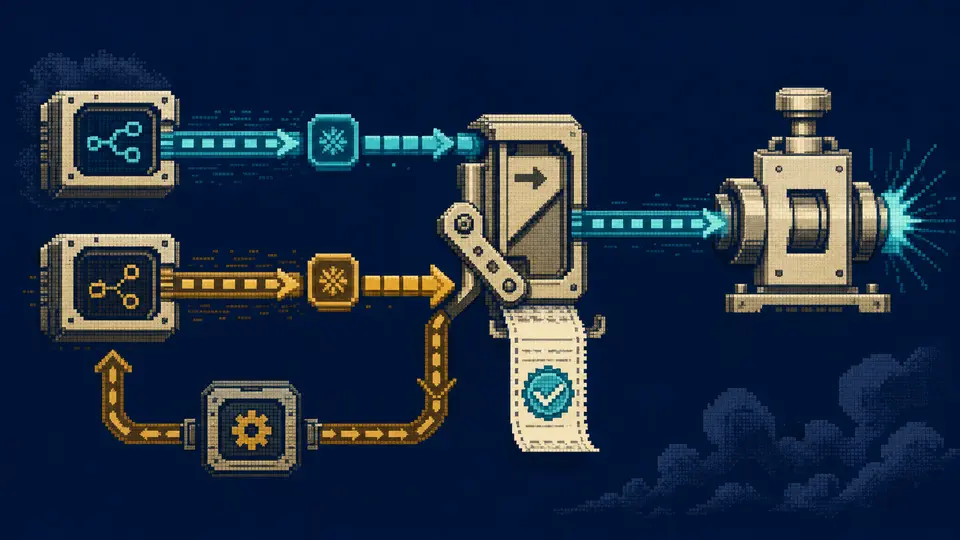
Approval belongs to the parameters
n8n's human-in-the-loop tool review pauses the workflow before selected AI tools run. The reviewer sees the tool and the parameters the AI supplied. Approval executes that input; denial cancels it. This is a strong primitive when the parameters themselves are sufficiently narrow.
The weak implementation sends a friendly message such as “approve the account update” while hiding a broad tool that accepts arbitrary fields. The stronger implementation shows the exact record identifier, fields, old values, proposed values, effect type, and packet digest. If any of those change after review, approval expires. The review channel can differ from the interaction channel, so identity and routing also need to be explicit.
On the OpenClaw side, tool policy should expose only the read and proposal capabilities needed for the reasoning phase. Deny rules win. Elevated execution is not a shortcut around that policy. If the final write remains available to the same unconstrained reasoning session, the architecture has quietly merged proposal and commit again.
What survives—and who should own it
Execution history is not infinite by default. n8n can save only selected execution outcomes and enables pruning by default. Its documented default thresholds are 336 hours or 10,000 finished executions, whichever condition is reached; new, running, waiting, and annotated executions receive different treatment. OpenClaw sessions and tasks also have maintenance and retention behavior. A two-month-old incident cannot be reconstructed from a record that was intentionally pruned after two weeks.
Choose the durable evidence before launch. Keep the packet digest, execution and session references, approval identity, idempotency key, remote receipt, final status, and redacted error class for the period required by operations. Do not retain raw prompts, tool results, or credentials merely because storage is available. n8n can redact execution input and output while retaining metadata; the hybrid packet should apply the same principle at the seam.
Retention is therefore part of the product decision. n8n offers an operator-facing execution model and configurable workflow data history. OpenClaw offers rich session continuity and detached-task lifecycle records. The application still needs a small domain ledger when the business meaning of a side effect must outlive either runtime's maintenance window.
Pick by the failure shape
Choose n8n as the owner when the work starts from a known trigger, follows typed transitions, needs visible per-run state, and must resume under a defined workflow retry policy. Choose an OpenClaw proposal when the difficult part is interpreting evidence, navigating tools, comparing uncertain sources, or carrying an operator conversation—and no external mutation should happen until another boundary accepts the result.
Use the hybrid when a durable workflow genuinely contains an open-ended reasoning step. Make n8n the default execution and commit owner, constrain OpenClaw to a digest-bound result, and require remote reconciliation before retry. Reverse that ownership only when the target application already supplies the transaction ledger, idempotency, receipt, and cancellation semantics that a conversational run does not.
That is the practical OpenClaw vs n8n answer. The products overlap at the tool surface, but their durable objects are different. A reliable design does not ask both to recover the same action. It decides who owns the retry before the first timeout makes the choice expensive.